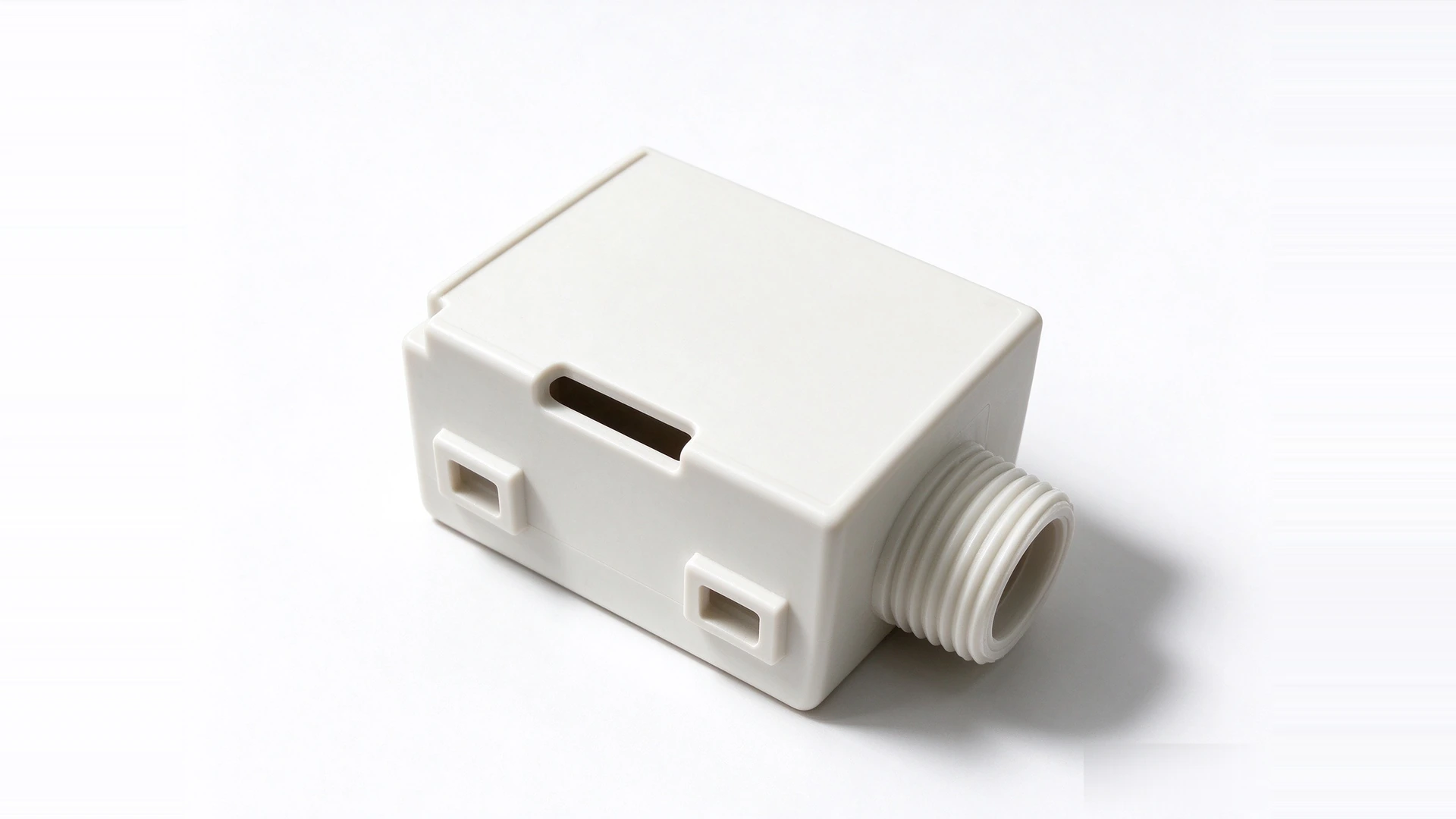


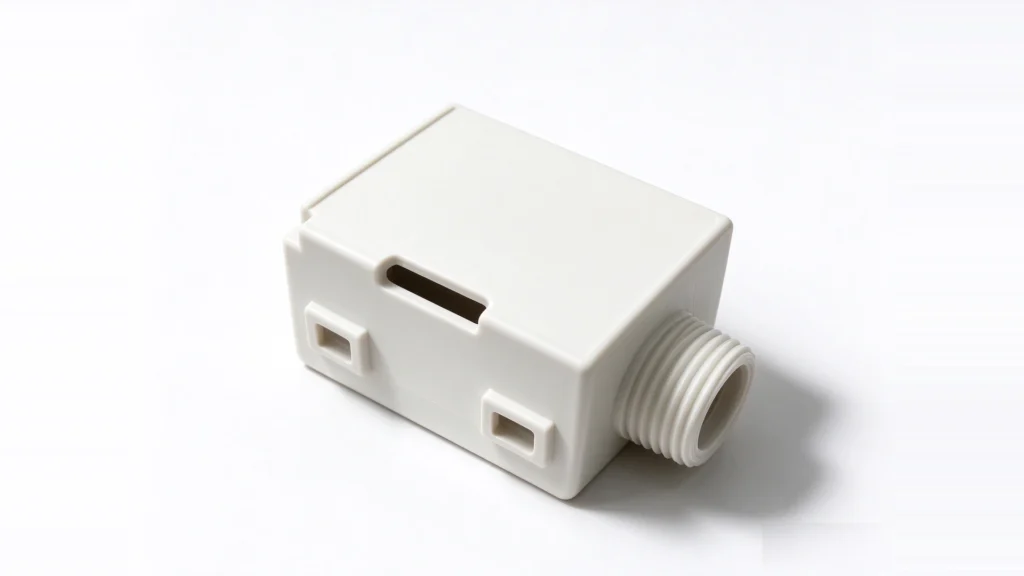
A US wireless communications manufacturer needed a plastic housing for a switch controller. On the drawing it is a box with walls and tolerances.
In the assembly it is something else: the surface a circuit board sits on, the edge that meets a panel, the part an end user touches every day.
That gap — between what the drawing says and what the assembly accepts — is where enclosure projects fail. And it is almost never closed by a better molder. It is closed by a review that happens before the steel is cut.
The Requirement Was Ordinary. The Consequence Was Not.
Three requirements, all of them standard for an electronic enclosure: dimensional accuracy, correct assembly fit, consistent quality across the run.
None of these is exotic. Together they are unforgiving, because a housing does not fail gradually. A housing that is a fraction of a millimetre out is not slightly out — it is a housing that will not close, or closes with a gap the end customer can see.
The client had already learned this. Their previous suppliers could not identify what was wrong after trial runs, and could not make the tool modifications that would have fixed it. The result was not a bad part. It was a delayed project and repeated rework, paid for twice.
Trial Samples Do Not Tell You What the Tool Should Have Been
This is the part most buyers get wrong, and it is worth being blunt about.
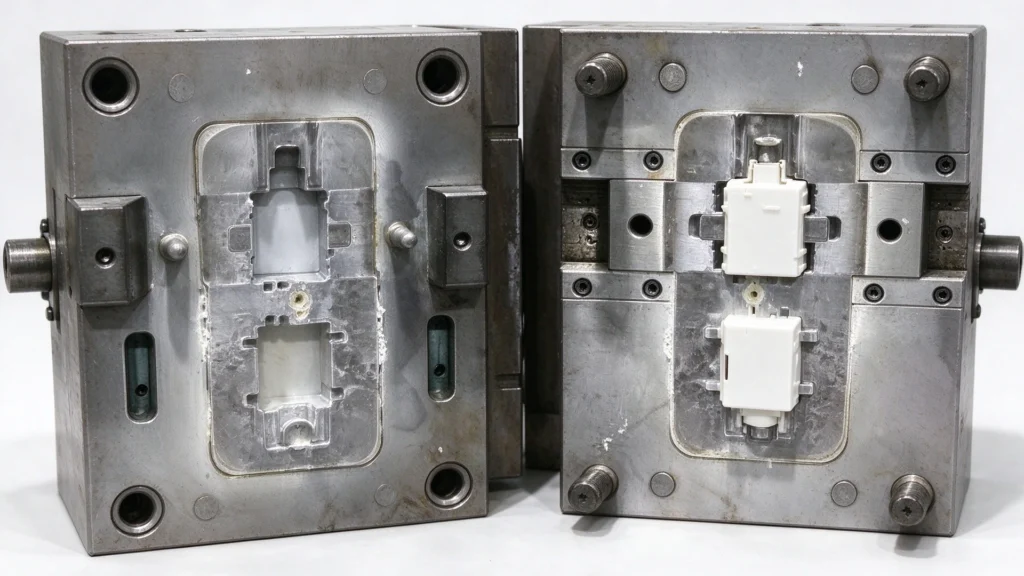
A trial sample tells you what the tool did. It does not tell you what the tool should have been. If nobody reviewed the design before the cavity was cut, then the first sample is also the first time anyone has looked properly at the part — and by then every correction is paid for in steel and calendar.
That is why “we can modify the mold after the trial” is a weak promise on its own. Modification capability is real, but it is a recovery skill, not a plan. What decides whether a project runs smoothly is whether the design got read before anyone committed to it.
Before steel, a design comment is an opinion. After steel, it is a quotation.
What a Drawing Review Actually Catches
We reviewed the housing in 2D and 3D before any tooling was committed, and looked at four things.
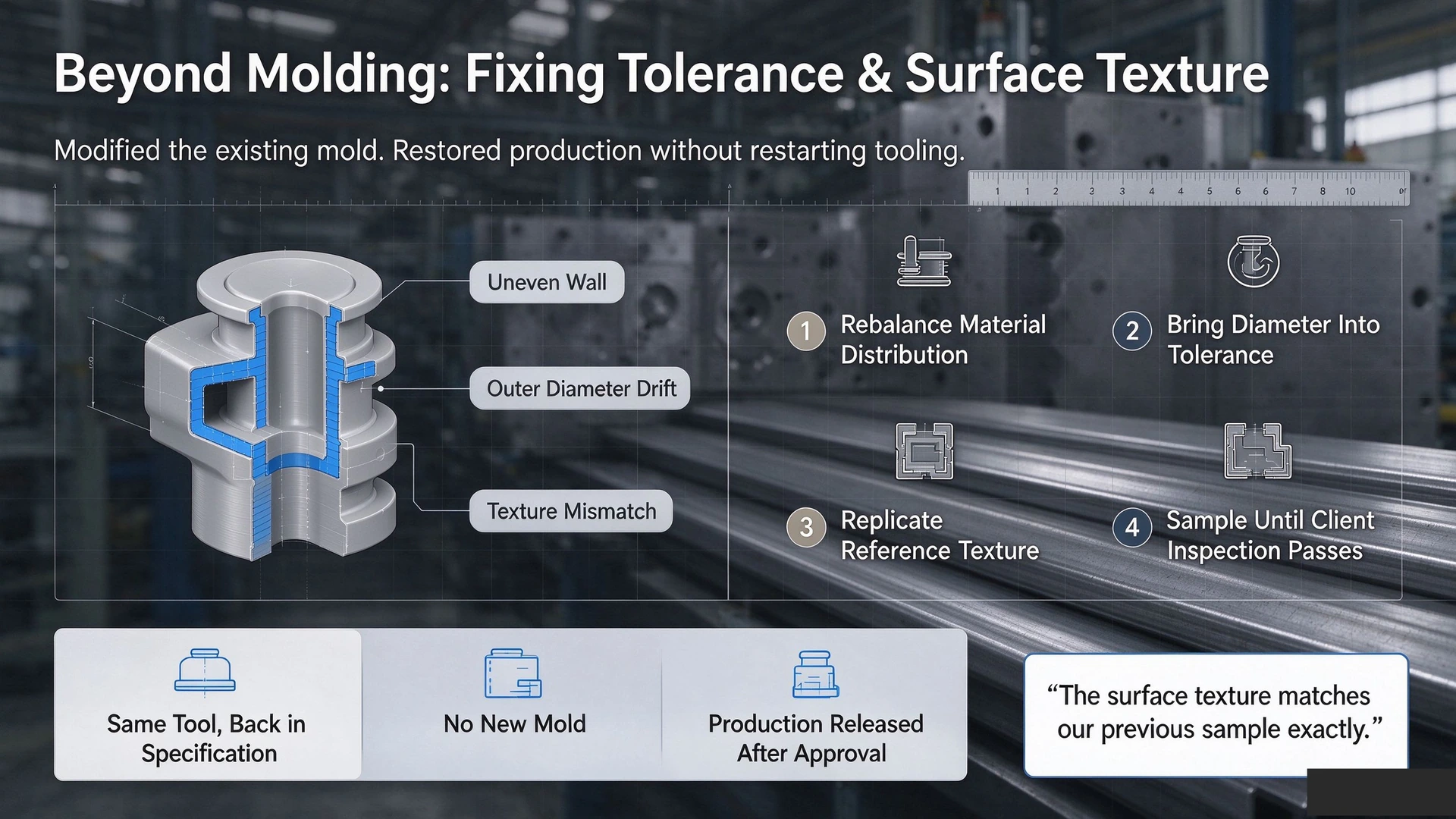
Wall thickness distribution. Uneven walls shrink unevenly. The part warps, sinks, or pulls out of flat — and this is the one class of problem that a mold modification cannot fully fix, because the fault is in the part design, not in the cavity. It has to be caught on the drawing or it is caught in production.
Tolerance stack-up, not individual tolerances. A dimension can be perfectly in tolerance and still not assemble, because the housing does not close against a drawing. It closes against a PCB, a switch, a panel, a gasket. What matters is the accumulated result of every part in that chain, not the size of yours.
Molding feasibility. Draft for ejection, gate position, where the parting line lands, whether a cosmetic surface gets a witness mark. These are the details that decide whether a housing that measures correctly also looks correct.
Where the design has no answer yet. Some questions cannot be settled on paper — how the part seats against the board, how a snap feels, whether a seam reads as a line or as a defect. Those are exactly the ones a trial sample exists to answer.
The Sequence We Ran
1. Drawing review and manufacturability confirmation. Wall thickness, tolerances, feasibility — reviewed and signed off before mold making started.
2. Custom mold design and fabrication. Built to the reviewed design, with dimensional control suited to an electronic enclosure rather than a general-purpose part.
3. Trial molding and first samples. Samples went to the client for their own inspection and their own assembly test — not for our opinion of them.
4. Targeted mold modification from sample feedback. After the client assembled the samples, we modified the tool in the specific places the trial had exposed. This is a normal part of a healthy project, not evidence that the review failed: a good review shrinks modification down to the questions the drawing genuinely could not answer.
5. Sample re-validation. Revised samples went back to the client for confirmation before anything was produced.
6. Production and delivery. After approval, production ran and finished housings shipped on schedule.
What Came Out of It
- Drawing reviewed and manufacturability confirmed before mold making
- Trial samples delivered and evaluated by the client against their own assembly
- Mold modifications completed from the client’s feedback
- Revised samples approved, with dimensional requirements met
- Finished housings delivered on schedule
What the Client Said
“Your team’s ability to make targeted mold modifications after trial runs was exactly what we were looking for.”
“The final housing samples met all our dimensional requirements. Assembly fit was perfect.”
Sourcing an Enclosure? Ask for the Review First
If you are quoting a custom plastic enclosure, the thing worth asking for is not the price of the tool. It is what the supplier says about your drawing before they quote it.
A supplier who returns a mold price with no comments on wall thickness, draft, tolerance stack-up, gate position or parting line is quoting steel. You are buying a part, and the part is the thing that has to close.
Send us the drawing and the parts it has to fit →
What to send
- The housing drawing — 2D and 3D (STEP is best)
- The PCB, switch or panel it has to assemble against
- Material, and any cosmetic or texture requirement on visible surfaces
- Quantity and target market
What comes back
- A manufacturability note: wall thickness, draft, tolerance stack-up, gate and parting-line placement
- The risks we would flag before tooling, stated plainly
- A tooling and part quote that separates the two
If the design has a problem that will cost you money later, we would rather say it now — when it is still an opinion.